
Click Image for Gallery
Are you ready to meet New 2026 Year in Brazil, Argentina, Chile, Bolivia & Peru?
Day 1 (30.12): Arrival in Rio de Janeiro
Your New Year tour to vibrant Rio de Janeiro starts the moment you land. A transfer takes you to your hotel. Along the way, you catch glimpses of grey granite peaks, lush greenery on the hillsides, and flashes of water – Guanabara Bay. As evening falls, light spreads across the slopes, car headlights illuminate viaducts and off-ramps, and the city's dramatic terrain becomes more visible.
Street vendors sell more than just coconuts and water – they offer simple New Year items: white bracelets, wreaths, and flowers. Wearing white on New Year's Eve in Rio is a tradition, symbolizing peace and renewal. Along the famous Copacabana beach, stages and lighting towers are already being set up, as in Rio de Janeiro, the beaches are the heart of the celebration. You will be part of one of the biggest parties on the coast. Welcome to the group New Year tour in Rio – loud, warm, and charged with anticipation!
Street vendors sell more than just coconuts and water – they offer simple New Year items: white bracelets, wreaths, and flowers. Wearing white on New Year's Eve in Rio is a tradition, symbolizing peace and renewal. Along the famous Copacabana beach, stages and lighting towers are already being set up, as in Rio de Janeiro, the beaches are the heart of the celebration. You will be part of one of the biggest parties on the coast. Welcome to the group New Year tour in Rio – loud, warm, and charged with anticipation!
countries/brazil/new-pics/rio/micaela-parente-1309093-unsplash.jpg
Day 2 (31.12): Rio de Janeiro – Corcovado and New Year on Copacabana
After breakfast, an English-speaking guide will take you on an excursion to Corcovado Mountain to see the iconic Christ the Redeemer statue. For some, this place holds a special meaning – a moment of quiet reflection over the bustling city, a chance to touch the monument. You'll also have time to rest before the evening festivities.
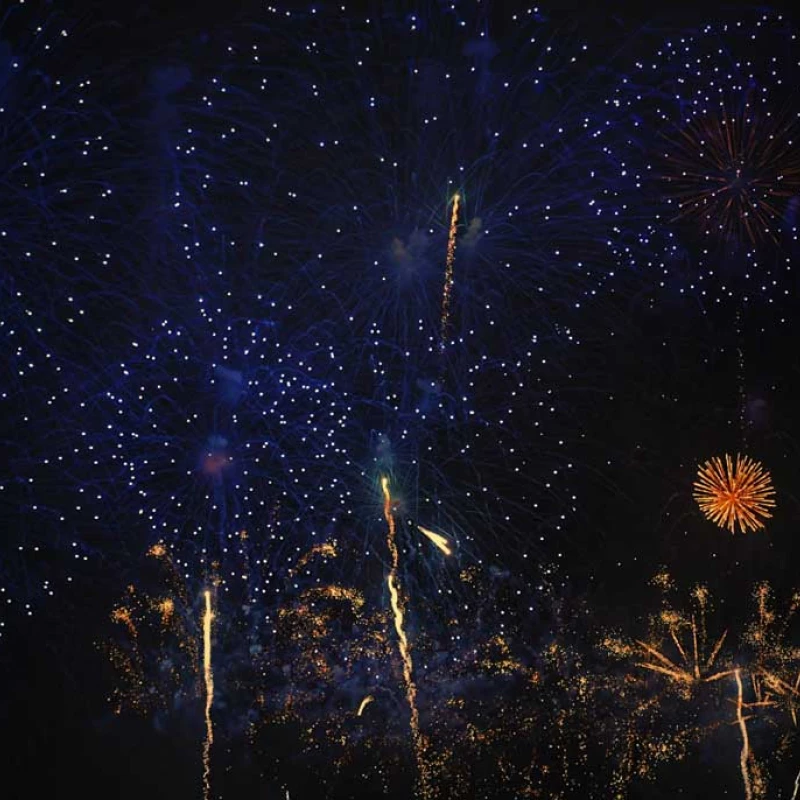
How is New Year celebrated in Rio de Janeiro? Copacabana becomes the city's main stage. Rio turns to the ocean, and people in white send offerings – flowers and gifts in small boats – to the sea goddess Iemanjá. Fireworks launch from platforms on the water, reflecting in the dark ocean. As night falls, thousands gather on Copacabana beach. Believers bring their offerings, setting flowers and gifts adrift in small boats. During the fireworks display, it's a truly spectacular sight: dark water, tiny boats, and a crowd dressed in white. Brazilian stars perform on the main stages. This is New Year in Brazil 2027 – such is the tradition!
*As an alternative to celebrating directly on the beach, you may book a New Year's dinner or a party at one of the hotels along the Copacabana waterfront. Booking and pricing are available upon request.
If the electric energy of Copacabana's New Year celebration captivates you, our Rio Carnival Champions Parade tour offers an equally spectacular spectacle with samba, costumes, and the world-famous parade.
How is New Year celebrated in Rio de Janeiro? Copacabana becomes the city's main stage. Rio turns to the ocean, and people in white send offerings – flowers and gifts in small boats – to the sea goddess Iemanjá. Fireworks launch from platforms on the water, reflecting in the dark ocean. As night falls, thousands gather on Copacabana beach. Believers bring their offerings, setting flowers and gifts adrift in small boats. During the fireworks display, it's a truly spectacular sight: dark water, tiny boats, and a crowd dressed in white. Brazilian stars perform on the main stages. This is New Year in Brazil 2027 – such is the tradition!
*As an alternative to celebrating directly on the beach, you may book a New Year's dinner or a party at one of the hotels along the Copacabana waterfront. Booking and pricing are available upon request.
If the electric energy of Copacabana's New Year celebration captivates you, our Rio Carnival Champions Parade tour offers an equally spectacular spectacle with samba, costumes, and the world-famous parade.
countries/brazil/new-pics/new-year/ny2.jpg
Day 3 (01.01): Rio de Janeiro – Sugarloaf Mountain and City Tour
What to do in Rio after New Year's? Spend the day at a relaxed pace, with plenty of scenic views. Your English-speaking guide will lead you to Red Beach, from where you'll take a cable car up to Urca Hill, and then to Sugarloaf Mountain. From here, Rio feels closer and more vivid – you can really sense the ocean, the bay, Copacabana beach, the surrounding rocks and islands, and the city's silhouette stretching between sea and mountains. Afterwards, you'll enjoy a city tour of Rio de Janeiro. Rio itself is one of Brazil's main attractions: colonial buildings, old churches and monasteries, the main cathedral, and squares where the modern metropolis blends with its Portuguese past.
*Due to heavy traffic during the New Year holidays, the order of stops may be adjusted.
*Due to heavy traffic during the New Year holidays, the order of stops may be adjusted.
countries/brazil/new-pics/rio/rio-22.jpg
Day 4 (02.01): Free Day in Rio
A free day! The weather in Rio in January hovers around +30°C, with humid air and strong sun, often followed by a short tropical rain in the afternoon. A January holiday in Brazil calls for simple essentials: light clothing, plenty of water, and an umbrella at hand.
If you're traveling to Brazil for the New Year holidays, be prepared that the country doesn't return to its regular rhythm immediately. Hotels are still full, beaches are crowded, and Copacabana is only just being tidied up. Use this day for leisurely walks in Ipanema: a slow breakfast, a stroll by the ocean, a seafood lunch. For a more urban experience, head to the neighborhoods around Lagoa Rodrigo de Freitas, where people relax, jog, and sit in cafés by the water. For shopping and cafés, it’s better to head towards Ipanema or Leblon.
If you're traveling to Brazil for the New Year holidays, be prepared that the country doesn't return to its regular rhythm immediately. Hotels are still full, beaches are crowded, and Copacabana is only just being tidied up. Use this day for leisurely walks in Ipanema: a slow breakfast, a stroll by the ocean, a seafood lunch. For a more urban experience, head to the neighborhoods around Lagoa Rodrigo de Freitas, where people relax, jog, and sit in cafés by the water. For shopping and cafés, it’s better to head towards Ipanema or Leblon.
countries/brazil/new-pics/rio/3.jpg
Day 5 (03.01): Rio de Janeiro – Foz do Iguaçu
The New Year in Rio is over, but the South America tour is just beginning. After breakfast and a transfer, you'll fly to Foz do Iguaçu. Upon arrival, a driver will meet you and take you to your hotel. After New Year in Rio, the Iguazu Falls serve as a powerful shift in mood. You move from the city heat to a humid forest with red earth and waterfalls so powerful you can hear them long before you see them. During the New Year holidays, Iguazu Falls are at their most spectacular. This is the rainy season, so the river is fuller, and the walkways and viewing platforms may be wet even without rain. The waterfall is not a single stream but a whole line of cascades. The water doesn't just fall – it shatters against the rocks, hangs in the air as fine droplets, and settles on your skin. Surrounding it is the Iguazu National Park, a subtropical forest home to thousands of plant and animal species, including tapirs, anteaters, howler monkeys, ocelots, caimans, and even jaguars.
If the raw power of Iguazu and the surrounding subtropical forest inspire you, our Brazil Carnival, Iguazu & Beach Tour combines the falls with Rio's Carnival energy and the pristine beaches of the Costa Verde.
If the raw power of Iguazu and the surrounding subtropical forest inspire you, our Brazil Carnival, Iguazu & Beach Tour combines the falls with Rio's Carnival energy and the pristine beaches of the Costa Verde.
countries/brazil/new-pics/iguasu/gabor-sz-5rbqw61losu-unsplash.jpg
Day 6 (04.01): Foz do Iguaçu – Brazilian Side of the Falls
After breakfast, an English-speaking guide will take you on an excursion to the Brazilian side of Iguazu Falls. This is your chance to take in the full line of cascades: water plunging from dark cliffs, shattering below and rising as white mist. Even on a sunny day, it's easy to get soaked without rain. Spray lands on your glasses, phone, hair, and sleeves. The roar is so intense that conversations gradually fade away. At the most powerful part of the system, the Devil's Throat canyon, the waterfall roars at full force, and the air grows heavy with moisture. Most of the main river channel plunges here. You can stand for a long time, mesmerized, watching the powerful flow, enjoying the sheer scale of one of Brazil's greatest natural wonders.
countries/brazil/new-pics/iguasu/henrique-felix-7hralhqan4s-unsplash.jpg
Macuco Safari: Great Adventure Boat Trip*
Macuco Safari (USD 130 per person) offers a completely different perspective on Iguazu – almost from river level, providing unique angles for photography. First, you'll ride through the forest in an open jeep while your guide shares insights about the region's ecosystem. Then, in a motorboat, you'll navigate the river to get closer to the waterfalls. Here, the cascades are no longer a line on the horizon – you feel them with your entire body.
countries/brazil/new-pics/iguasu/img-20210331-wa0177.jpg
Bird Park*
Bird Park (USD 50 per person) is located near the entrance to Iguazu National Park. It’s more than just an aviary – it's a center dedicated to the birds of the Atlantic Forest and a sanctuary for rescued animals. The route follows a trail of about 2 km, and in the large enclosures, birds can fly close to visitors. Macaws perch on branches at eye level, toucans turn their heavy beaks, and pink flamingos stand out beautifully against the dark green foliage.
countries/brazil/new-pics/iguasu/mateus-campos-felipe-1629321-unsplash.jpg
Day 7 (05.01): Foz do Iguaçu – Buenos Aires
After breakfast, you'll cross to the other side to see the Iguazu Falls from Argentina. The Tancredo Neves Bridge, the border – and you're on the route. Here, there are more pedestrian walkways and crossings, allowing you to view the Iguazu system almost from the inside: from above, next to the streams, on walkways over the water. Before you lies the flat river, then the edge of the basalt cliff – and you see the stream plunge dramatically downward. An ecological train takes you to the Devil's Throat. You walk on walkways over the calm, wide river towards the viewing platform, and it's hard to believe there's a precipice nearby. But beyond that – it’s a feeling that cannot be described in words. After the tour, you'll be transferred to the airport for your flight. Upon arrival in the Argentine capital of Buenos Aires, a driver will meet you and take you to your hotel.
countries/argentina/new-photos/buenos-ajres/ba4.jpg
Day 8 (06.01): Buenos Aires – City Tour and Tango Show
Welcome to the capital of Argentina! An English-speaking guide will introduce you to Buenos Aires and its landmarks. Colonial squares and European facades, historic and modern neighborhoods, and wide boulevards – the city has many French and Italian architectural influences, but Buenos Aires has a character all its own.
What to see in Buenos Aires? You'll visit the heart of the city – Plaza de Mayo, with the Casa Rosada and the cathedral. You'll explore the old port district of La Boca, the intimate San Telmo with its cobblestone streets, low facades, antique shops, bars, and street musicians. Then there's elegant Recoleta, famous for its cemetery. You'll also see the wide Avenida 9 de Julio with the Obelisk and the modern Puerto Madero, with its waterfront promenades, restaurants, and parks. In the evening, you'll attend a tango show with dinner and excellent Argentine wines. The orchestra, singers, and couples perform the subtle dance. The man leads with his body, and the woman responds with precise footwork, a pause, a hip turn – steps that contain both conflict and harmony. A good tango is mesmerizing. A trip to Argentina would be incomplete without experiencing its tango.
If the passion of tango and the elegant streets of Buenos Aires enchant you, our Dreams Come True tour of Brazil and Argentina blends Iguazu Falls, Patagonia, and the sophisticated cities of Buenos Aires and Rio de Janeiro.
What to see in Buenos Aires? You'll visit the heart of the city – Plaza de Mayo, with the Casa Rosada and the cathedral. You'll explore the old port district of La Boca, the intimate San Telmo with its cobblestone streets, low facades, antique shops, bars, and street musicians. Then there's elegant Recoleta, famous for its cemetery. You'll also see the wide Avenida 9 de Julio with the Obelisk and the modern Puerto Madero, with its waterfront promenades, restaurants, and parks. In the evening, you'll attend a tango show with dinner and excellent Argentine wines. The orchestra, singers, and couples perform the subtle dance. The man leads with his body, and the woman responds with precise footwork, a pause, a hip turn – steps that contain both conflict and harmony. A good tango is mesmerizing. A trip to Argentina would be incomplete without experiencing its tango.
If the passion of tango and the elegant streets of Buenos Aires enchant you, our Dreams Come True tour of Brazil and Argentina blends Iguazu Falls, Patagonia, and the sophisticated cities of Buenos Aires and Rio de Janeiro.
countries/argentina/new-photos/daniel-tong-vtjtaz-rxxi-unsplash.jpg
Day 9 (07.01): Buenos Aires – Santiago de Chile
Breakfast, transfer to the airport, flight. In Santiago, a driver will meet you and take you to your hotel. The "5 Countries of Latin America" New Year tour now enters a new phase – your journey through Chile begins. In the north lies the Atacama Desert, one of the driest places on Earth. In the center, Santiago, the wine regions of Chile, and roads to the Pacific. In the south – lakes, volcanoes, glaciers, and Patagonia.
The modern city of Santiago is a city where the Andes, dry light, and wide city avenues come into frame. The country stretches between the mountains and the Pacific Ocean. On clear days, the mountains are visible right from the city – beyond the streets, glass towers, and residential neighborhoods. They are not just a decorative backdrop but a constant presence. Chile's capital is modern and business-oriented, with wide avenues, parks, cafés, museums, and districts where old buildings stand alongside skyscrapers. The weather in Chile in January varies greatly by region. In the center, it's usually hot and dry, 28–32°C, with almost no rain.
The modern city of Santiago is a city where the Andes, dry light, and wide city avenues come into frame. The country stretches between the mountains and the Pacific Ocean. On clear days, the mountains are visible right from the city – beyond the streets, glass towers, and residential neighborhoods. They are not just a decorative backdrop but a constant presence. Chile's capital is modern and business-oriented, with wide avenues, parks, cafés, museums, and districts where old buildings stand alongside skyscrapers. The weather in Chile in January varies greatly by region. In the center, it's usually hot and dry, 28–32°C, with almost no rain.
countries/chile/santiago-2.jpg
Day 10 (08.01): Santiago de Chile – City Tour and Optional Maipo Valley
After breakfast, you'll go on a sightseeing tour of Santiago's landmarks with an English-speaking guide. First is La Moneda, one of the capital's most important buildings. Its calm, austere facade and unusual history – the palace started as a mint and later became the government residence – make it a fascinating stop. Next, you'll head to Plaza de Armas, the historic heart of the city, including the cathedral and the former Royal Audience building. A short climb in the city center brings you to Santa Lucía Hill, from where you can see the roofs, avenues, and, if the air is clear, the line of the Andes. Finally, you'll explore the modern neighborhoods of Vitacura, Las Condes, and Providencia – glass towers, hotels, restaurants, wider streets, and business districts.
*For an additional cost, you can visit the Maipo Valley. This is the home of Chilean Cabernet Sauvignon – a trip to Chile is incomplete without tasting it. Tastings are held among the vineyards and old cellars (USD 230 per person, minimum 2 people).
For travelers who appreciate world-class wines and the dramatic backdrop of the Andes, our Chile VIP Tour with gourmet dining and desert landscapes combines the best of Santiago with the otherworldly landscapes of the Atacama Desert and private chef dining experiences.
*For an additional cost, you can visit the Maipo Valley. This is the home of Chilean Cabernet Sauvignon – a trip to Chile is incomplete without tasting it. Tastings are held among the vineyards and old cellars (USD 230 per person, minimum 2 people).
For travelers who appreciate world-class wines and the dramatic backdrop of the Andes, our Chile VIP Tour with gourmet dining and desert landscapes combines the best of Santiago with the otherworldly landscapes of the Atacama Desert and private chef dining experiences.
countries/chile/chi-santiago-left.jpg
Day 11 (09.01): Santiago de Chile – San Pedro de Atacama
A transfer will take you to the airport for your flight to Calama, and from there, another transfer will bring you to the oasis town of San Pedro de Atacama for acclimatization before the journey to Uyuni. After arriving in Calama, it's wise to pause and not overexert yourself – allow your body to adjust to the altitude, dry air, and intense sun.
In the evening, you can join a group astronomy tour. In San Pedro, darkness falls quickly: during the day there's dust, sun, and volcanoes, but at night, the desert sky reveals a different world. The group is usually taken outside the town to observe constellations, the Milky Way, planets, and the Moon through professional telescopes. An English-speaking guide will explain what you see. Through the telescopes, the sky is no longer just a beautiful background – you can see lunar craters, Saturn's rings, and star clusters. The cost is USD 150 per person. The tour is not available during bright moon phases or full moons.
If you are captivated by the star-studded skies of the Atacama and the high-altitude desert landscapes, our Great South America tour connects you to the continent's most spectacular mountain and desert scenery.
In the evening, you can join a group astronomy tour. In San Pedro, darkness falls quickly: during the day there's dust, sun, and volcanoes, but at night, the desert sky reveals a different world. The group is usually taken outside the town to observe constellations, the Milky Way, planets, and the Moon through professional telescopes. An English-speaking guide will explain what you see. Through the telescopes, the sky is no longer just a beautiful background – you can see lunar craters, Saturn's rings, and star clusters. The cost is USD 150 per person. The tour is not available during bright moon phases or full moons.
If you are captivated by the star-studded skies of the Atacama and the high-altitude desert landscapes, our Great South America tour connects you to the continent's most spectacular mountain and desert scenery.
countries/bolivia/matan-levanon-qchr30s1r4c-unsplash.jpg
Day 12 (10.01): Uyuni (Bolivia, Jeep Tour)
Crossing from Chile into Bolivia marks the start of your Bolivia tour: you'll travel in 4x4 jeeps across the high-altitude desert. Around you – dry earth, sparse shrubs, distant volcanoes, and a vast sky. You'll see many of Bolivia's natural wonders. The first is Laguna Verde – a saline high-altitude lake with a sharp shoreline and the cone of Licancabur volcano on the horizon. You'll be amazed by the Valle de Dalí with its stone sculptures, seemingly placed by hand amidst the emptiness. You'll visit the Polques hot springs and the Sol de Mañana geysers, which smell of sulfur and emit a boiling, ochre-gray mixture. Finally, you'll reach Laguna Colorada – a shallow, saline lake with salt bands at the shore, wind across the water, and James's flamingos, as well as Andean and Chilean flamingos, feeding in the shallows. After this untamed Bolivia expedition, you'll rest in a simple desert hotel, reminiscent of an expedition camp.
countries/bolivia/22.jpg
Day 13 (11.01): Uyuni (Jeep Tour)
After breakfast, the road continues across the Altiplano. You'll see the lagoons of Chiarkhota, Honda, Hedionda, and Cañapa, where flamingos gather by the water, the shores are white with salt, and the wind creates ripples on the surface. At the Ollagüe volcano, you'll stop at a viewpoint. The landscape is almost motionless: rocks by the road, a dry slope, an empty horizon – only a thin wisp of smoke above the crater reminds you the volcano is still active. You'll pass through Chiguana, a salt flat, and in Colchani, you'll see how local people work with salt: collecting it into cones, drying it in the sun, and loading it into sacks. Then it's on to the "Eyes of Water" and Incahuasi Island with its giant cacti. Finally - the surreal Salar de Uyuni (Uyuni Salt Flats), Bolivia, one of the country's greatest natural wonders. A white desert with hexagon-shaped salt patterns, sometimes covered with a thin layer of water that reflects the sky beneath the jeeps' wheels. In such a landscape, your sense of distance quickly disappears. Lunch is a boxed lunch. After the tour, you'll be transferred to Uyuni.
If you are drawn to otherworldly landscapes and high-altitude adventure, our 5-Country South America Group Tour takes you across the continent's most remote and spectacular scenery, from the Uyuni Salt Flats to the Inca Trail.
If you are drawn to otherworldly landscapes and high-altitude adventure, our 5-Country South America Group Tour takes you across the continent's most remote and spectacular scenery, from the Uyuni Salt Flats to the Inca Trail.
countries/bolivia/trevor-mckinnon-y-z-ltvmjdg-unsplash-2.jpg
Day 14 (12.01): Uyuni – La Paz
A transfer will take you to the airport for your flight to La Paz. It's often called Bolivia's capital, though the official capital is Sucre. If there is no flight, you'll travel by comfortable night bus. A driver will meet you and take you to your hotel. After the salt flats, La Paz seems immense. It lies in a deep basin, with slopes rising all around. La Paz, Bolivia: what to see? You'll be shown its bustling center, churches, and Murillo Square – where government buildings are located, as well as the church of San Francisco built from warm terracotta stone. You'll also visit the unusual Witches' Market, where herbs, amulets, incense, and dried llama fetuses are sold. Then, you'll head to the Moon Valley: its unique relief was formed by soft clay and sandstone layers, carved by water and wind over thousands of years into narrow towers, ribbed walls, and frozen "waves" of earth.
countries/bolivia/la-paz-2.jpg
Day 15 (13.01): La Paz – Tiwanaku – Puno – Uros Islands
After breakfast, you'll head towards the Peruvian border. Your Peru excursion tour is about to begin! Scattered settlements, women in hats, roadside markets, and mountains on the horizon. Along the way, you'll visit one of the main pre-Inca centers of the Andes – the ruins of Tiwanaku. You'll see the Gate of the Sun, a stone portal with carvings, and the Kalasasaya temple, often linked to astronomical observations. You'll learn about the technologies of the Tiwanaku culture and why it eventually declined. After the excursion, you'll pass through Desaguadero on the border with Peru, and a transfer will take you to your hotel in Puno, Peru. Puno sits on the shores of Lake Titicaca and is often seen as a gateway to the lake. It's cooler than you might expect: the altitude is about 3,800 meters, with wind from the water, bright sunshine during the day, and cold evenings. In the afternoon, you'll take a boat to the Uros floating islands, made of totora reeds. Beneath your feet, the island feels soft and springy, and local families show you how they layer the reeds and build boats, roofs, and floors from them.
countries/peru/poezd-belmond-andean-explorer/6.jpg
Day 16 (14.01): Puno – Cusco
After breakfast, you'll be transferred to the bus station for the journey to Cusco, Peru, in a tourist bus. Along the way, you'll stop at Andahuaylillas, a village famous for its Church of Saint Peter, built in the late 16th to early 17th century, and covered inside with frescoes, gold leaf, and Baroque paintings combined with local traditions. Next, you'll visit Raqchi, one of the most unusual Inca archaeological sites, with its enormous temple dedicated to the creator god Viracocha. After lunch in Sicuani, you'll head to La Raya pass, with views of the snow-capped Andes peaks, often with a local market offering alpaca wool products and souvenirs. You'll also stop in Pucara, a center of pre-Inca culture known for stone sculpture, pottery, and high-altitude settlements. Finally, you'll arrive in Cusco, the former Inca capital. Here, narrow streets climb uphill, ancient stone walls stand beside colonial facades, and the air quickly turns cool after sunset. Transfer to your hotel.
countries/peru/kusko/cusco-4.jpg
Day 17 (15.01): Machu Picchu
After breakfast, you'll set out on an excursion to Machu Picchu with an English-speaking guide. This wonder of the world is believed to have been built for the Inca ruler Pachacuti. The journey itself is an adventure: the train runs along the Urubamba River, the green slopes draw nearer, and the final switchback road climbs to the entrance. Then, the ancient Inca city reveals itself before you: terraces descending the slopes, surrounded by misty green peaks. The terraces of Machu Picchu look like steps carved into the mountain. They held the soil, channeled water, and allowed crops to grow where a normal field would have slid away. Here, you see how the Incas integrated their city into the mountain, using every ledge rather than cutting it away. During the tour, you'll walk through plazas, stairways, residential areas, and temple zones. The stones here are fitted so precisely that the seams are barely visible. Without mortar or excess decoration – only precise work with form, weight, and angle. After the excursion, you'll have lunch, then return to Cusco by train.
If the ancient stonework of Machu Picchu and the high-altitude landscapes of the Andes inspire you, our VIP Tour in Peru offers an even deeper journey into the heart of the Inca Empire, from the Sacred Valley to Rainbow Mountain.
If the ancient stonework of Machu Picchu and the high-altitude landscapes of the Andes inspire you, our VIP Tour in Peru offers an even deeper journey into the heart of the Inca Empire, from the Sacred Valley to Rainbow Mountain.
countries/peru/babak-fakhamzadeh-2994-unsplash.jpg
Day 18 (16.01): Cusco – Lima
After breakfast, an English-speaking guide will take you on a city tour of Cusco. The city sits high, so mornings can be cool. You'll visit the Temple of the Sun – Coricancha, one of the main sanctuaries of the Inca capital. After the Spanish arrival, the Santo Domingo monastery was built on its foundations. You'll also explore Qenqo, a ritual center with rock passages, carved channels, and niches; Puca Pucara, a red fortress that served as a fortified complex with terraces, courtyards, and views of the valley; and Tambomachay, where you'll learn how the Incas carved channels and used cascades. Finally, you'll see Sacsayhuamán, an impressive fortress with colossal stone blocks fitted without mortar, zigzagging walls, and a stunning view over almost all of Cusco. Afterwards, you'll be transferred to the airport for your flight to Lima, with a transfer to your hotel upon arrival.
countries/peru/lima/aarom-ore-yrqyn1gb80k-unsplash.jpg
Day 19 (17.01): Lima – City Tour and Departure
Breakfast, then head out for a sightseeing tour of Lima with an English-speaking guide. What to see in Lima? Colonial plazas, old facades, cathedrals, and unique museums. You'll start in the modern neighborhood of Miraflores, where the Love Park sits right above the coastline with its mosaics and sculpture of a couple, while the Pacific Ocean roars below. Then, you'll see the ancient adobe pyramid of Huaca Huallamarca, surrounded by offices and residential buildings. On Lima's main square, you'll see the Presidential Palace and the city hall, and visit the cathedral – a cool haven after the hot streets. If closed, you'll head to the MALI art museum with its collection of pottery, paintings, and religious art. Next, you'll visit the Santo Domingo Monastery, whose courtyards and narrow lanes recall Saint Martin de Porres and Saint Rose of Lima. Finally, you'll visit the Larco Museum – a private mansion with a strong collection of pre-Columbian art, including a unique collection of erotic pottery. After the tour, a transfer will take you to the airport for your departure home.
countries/peru/lima/eduardo-garcia-crhwrtxodcw-unsplash.jpg
5 countries at New Year
PayPal
You can pay by simply choosing PayPal at checkout
Do you have questions?
Call us right now to get your questions answered.
-
 Package
- Booking Code: pb
- Availability: Available for Booking
- Total: $10,355