
Click Image for Gallery
Brazil, Argentina, Peru, and Chile together offer a captivating tapestry of vibrant cultures, breathtaking landscapes, and rich histories—from Brazil's lush Amazon and iconic beaches, Argentina's passionate tango and Andes peaks, Peru's mystical Machu Picchu and Incan heritage, to Chile's dramatic deserts and rugged Patagonia.
Day 1: Rio de Janeiro
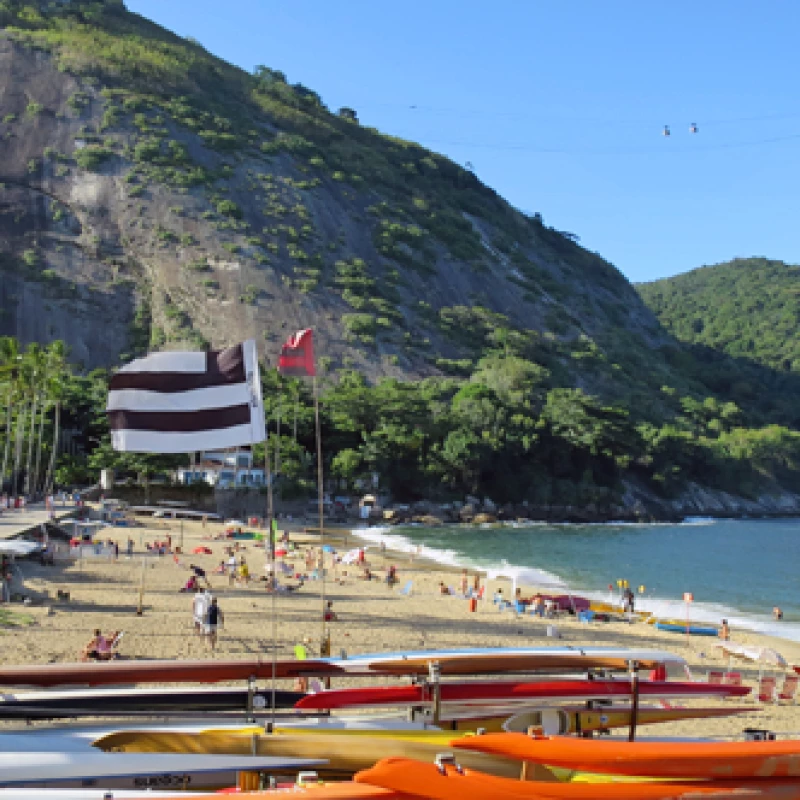
Arrival day in Rio de Janeiro! At the Rio de Janeiro International Airport, you will be met by your driver, who will transfer you to the hotel. The rest of the day is free to explore the city or enjoy your first day on the beautiful beaches of Rio de Janeiro.Rio de Janeiro is a city of green hills, blue skies, lovely bays, islands, and wonderful beaches. It is the second-largest city in Brazil (after São Paulo) and undoubtedly one of the most beautiful cities in the world! Beach hotels stretch along the entire Guanabara Bay, and if you stay in one of them, the beauty of Rio is always at your doorstep. The blue ocean waters invite you to the beach. The most popular beaches—Copacabana, Ipanema, and Leblon—are famous for their black-and-white mosaic promenades. From early morning until late in the evening, you can see people playing football and volleyball on the golden sand. For those who prefer an active vacation, Rio offers opportunities for almost every sport: golf, tennis, surfing, rafting, diving, hang gliding, and many more. Numerous open-air beach cafés will offer you refreshing coconut water, fresh juices, and other drinks. You may also see local musicians performing a variety of music right on the beach.
corcovado1.png
Day 2: Rio de Janeiro
After breakfast, you will have the opportunity to enjoy a half-day excursion to Corcovado Mountain. Upon arrival at the station, an eco-friendly train will take you through the jungle to the summit of Corcovado. On both sides of the railway, you will admire breathtaking views of the Tijuca Forest, home to monkeys and other exotic animals and birds. At the top of Corcovado, at 700 meters above sea level, you will see the symbol of Rio de Janeiro—the 38-meter-high Christ the Redeemer Statue, built in 1931. From its summit, you will enjoy a spectacular panoramic view of the city and its surroundings, such as the Niterói Bridge, Guanabara Bay, the Botanical Garden, the Maracanã Stadium, and Sugarloaf Mountain.
countries/brazil/new-pics/rio-5.jpg
Day 3: Rio de Janeiro
After breakfast, you will have the opportunity to take a half-day excursion to Sugarloaf Mountain. The first stop is at Urca Hill, with a spacious viewpoint and a restaurant at the top where you can enjoy a snack. At the summit of Sugarloaf, you will admire a magnificent view of Rio, Copacabana Beach, the bay, the surrounding mountains, ocean islands, the Niterói Bridge, and the Christ Statue on Mount Corcovado. After descending by cable car, the tour will continue with a city tour.
Ipanema-Beach11.png
Day 4: Rio de Janeiro - Foz do Iguazu
Breakfast at the hotel. Transfer to the airport with your driver. Flight to Foz do Iguaçu. Arrival at Foz do Iguaçu Airport. You will be met by your driver, who will take you to the hotel. At the great Foz do Iguaçu Falls, you will find the tri-border area between Brazil, Paraguay, and Argentina. Once a border military post, the region developed thanks to construction and tourism. The Iguaçu Falls take their name from the Caigangue Indigenous language, meaning “great waters.” Formed by the Iguaçu River, the falls consist of 275 individual cascades surrounded by the pristine forest of Iguaçu National Park, home to about 2,000 plant species and 400 bird species (including parrots and toucans). The highest fall, the “Garganta do Diabo” (Devil’s Throat), reaches 70 meters (230 ft), one and a half times higher than Niagara Falls. You can also enjoy stunning views from one of the many walking trails, try rafting, or take an exhilarating boat ride under the waterfalls.
countries/brazil/file-106-3-waifu2x-noise1-1200.jpg
Day 5: Foz do Iguazu
Today, after breakfast at the hotel, you will visit the Brazilian side of the magnificent Iguaçu Falls. Following the walking trails that curve around the canyon of the Iguaçu River, you will admire hundreds of smaller waterfalls. At the end of this route, you will find yourself standing right in front of the immense and impressive Devil’s Throat, the most powerful of all the falls. You will feel the waterfalls up close, surrounded by mist and countless beautiful rainbows. At the end of the tour, your guide will take you back to the hotel.
countries/brazil/new-pics/vodopady-iguasu-8.jpg
Day 6: Foz do Iguazu Buenos Aires
Good morning! After breakfast at the hotel, our guide will pick you up for a full-day adventure on the Argentine side of Iguazú National Park. The Argentine side is very different from the Brazilian one; here you will find three trails that take you deep into the park’s natural scenery: Lower Trail: A 1,700-meter trail that winds through dense jungle and offers close-up views of the Dos Hermanas, Chico, and Ramírez waterfalls. Walking along this path, you may find yourself at the foot of the massive Salto Bossetti and enjoy the powerful falls at Saltos Alvar Núñez, Elena, and Lanusse. Upper Trail: A 1,300-meter elevated walkway that takes you to the top edge of several major waterfalls, providing sweeping views of the entire area from above. Devil’s Throat: Accessible through the tropical forest by an ecological train that stops at the Devil’s Throat Station. From there, after a 1,000-meter walk, you will reach the spectacular and colossal Devil’s Throat. You will be walking right beside the waterfalls, seeing them up close. You will feel the power of the water and enjoy 55,500 hectares of breathtaking natural beauty! After the tour, you will be taken to the airport for your flight to Buenos Aires. Upon arrival, you will be met by your driver and transferred to your hotel. Buenos Aires is famous as the birthplace of tango. Without a doubt, it is the best city in the world for fans of this legendary dance. You will also feel the extraordinary charm of this cosmopolitan capital, with its iconic Casa Rosada, the former port Puerto Madero, the colorful district Caminito, Florida Street, the Boca Juniors Stadium, the cathedral, the National Historical Museum, and the botanical garden. This diverse city is full of fascinating places—too many to list.
catalog/product/f/i/file_78_12.jpg
Day 7: Buenos Aires
After breakfast today, you will go on a half-day city tour of Buenos Aires. This panoramic tour will take you past the main highlights of the most European and cosmopolitan city in South America. We will drive along Avenida 9 de Julio, home to the famous Teatro Colón and the Obelisk, symbols of the city. We will visit Plaza de Mayo, surrounded by important historical buildings such as Casa Rosada, the cathedral, and the Town Hall. We will also visit Plaza San Martín, Avenida Alvear, and Plaza del Congreso. The tour continues along the historic Avenida de Mayo and the vibrant Avenida Corrientes. Explore colorful and historic neighborhoods such as La Boca and San Telmo, as well as the elegant districts of Palermo, Recoleta, and the modern Puerto Madero, a lively area filled with dining and entertainment. Return to the hotel for overnight.
countries/argentina/buenos-aires.jpg
Day 8: Buenos Aires
Today is a free day to enjoy the city as you wish! Alternatively, you may choose from a variety of optional excursions.
catalog/product/f/i/file_64_45.jpg
Day 9: Buenos Aires – Santiago de Chile
After breakfast at the hotel, you will be transferred to the international airport for your flight to Santiago de Chile. Upon arrival, you will be met and taken to your hotel. In the afternoon, you will go on a tour of Santiago’s most interesting attractions, starting in the historic city center. You will visit the Main Square, the cathedral, the Central Post Office, and the Santiago City Hall. We will see the La Moneda Government Palace, and then continue to Santa Lucía Hill, a small hill in central Santiago that is the remnant of a 15-million-year-old volcano. We will then head to East Santiago, where you can admire modern buildings, offices, apartments, shopping centers, and restaurants.
santiago de ch.png
Day 10: Santiago de Chile
Breakfast at the hotel. A full-day group excursion to Viña del Mar and Valparaíso. We will visit the Quinta Vergara amphitheater, where the annual Viña del Mar International Song Festival is held, San Martín Avenue, Peru Avenue, Sotomayor Square, the El Peral funicular, and the Yugoslav Corridor. Return to Santiago and overnight at the hotel.
countries/chile/chi-santiago-left.jpg
Day 11: Santiago de Chile- Lima
After breakfast at the hotel, you will be transferred to the international airport for your flight to Cusco. Upon arrival, you will be met and transferred to your hotel in the Sacred Valley.
lima3.png
Day 12: Sacred Valley
The Sacred Valley is the cradle of Inca civilization. It was famous for its fertility and favorable climate, making agriculture easy and producing rich harvests. The Incas built entire cities in the Sacred Valley, and today their ruins can still be seen: Urubamba with the country residence of the Inca Emperor Huayna Capac; the Pisac archaeological complex shaped like a partridge on the Vilcabamba hill; Ollantaytambo with its ceremonial center; Chinchero with an interesting colonial church built directly atop the walls of the Inca Temple of the Sun; and the beautiful Moray complex with agricultural terraces arranged like an amphitheater. Near Pisac, you can visit a local market and buy handmade silver, ceramics, and leather handicrafts. At the Awanakancha zoological center, you will see the region’s most iconic animals—llamas, alpacas, and vicuñas—and learn about how they are fed and how their valuable wool is dyed. Buffet lunch at the national cuisine restaurant Inka House.
Cuzco.png
Day 13: Sacred Valley – Machu Picchu – Cusco
Breakfast. We take the train to Machu Picchu, traveling through the Sacred Valley. The single-track railway runs along the right side of the canyon beside the roaring, rock-filled Urubamba River. Upon arrival in the small town of Aguas Calientes, a 30-minute bus ride will take you up to Machu Picchu. Machu Picchu, the Inca city with its labyrinth of finely crafted stone temples, houses, and fountains, sits on a ridge between two mountain peaks. It was hidden beneath thick vegetation until it was discovered by Hiram Bingham in 1911. We will take a guided tour. In the afternoon, lunch and return to Cusco by train. Transfer to the hotel.
Machu Picchu.png
Day 14: Cusco – Lima
After breakfast, you will take an excursion to the Sacsayhuamán complex, built during the Inca period. According to legend, people from other tribes were not allowed to enter this sacred site. Sacsayhuamán was considered a holy place for the Incas. Its ruler had to be of royal blood, as only kings could govern the House of the Sun, as the complex was considered. Peru is home to many ancient temples and architectural sites. Along with Sacsayhuamán, Qorikancha is also considered a Temple of the Sun. According to legend, the temple was built in the 15th century out of gold and glittered under the sun’s rays, attracting conquerors. Its interior was entirely covered in gold, and even the altar was shaped like a golden disk. But when the Spaniards arrived in the land of the Incas, they destroyed the temple and built their own monastery on its foundations. Later, an earthquake destroyed the Spanish monastery as well, and beneath its ruins, the strong stone blocks of Qorikancha were rediscovered. The next stop on our excursion is the Tambomachay water temple, also considered sacred by the Incas. It housed the Inca baths, where the Great Inca would come to bathe in the pool supplied by carefully constructed water channels. Very close to Tambomachay, you can also see another archaeological complex with unusual walls and towers—this is the Red Fortress, or Puka Pukara in the Inca language, which served as a military outpost. Transfer to the airport for your flight to Lima. Upon arrival, meeting and transfer to the hotel.
lima.png
Day 15: Lima – Back home
In the morning after breakfast, you will take a city tour that includes the main colonial sights such as the Main Square with its cathedral, the San Francisco Monastery, and many elegant buildings with traditional wooden balconies that are now being restored. You will then visit the residential districts of Lima: San Isidro with its olive grove, country club, and golf course, and Miraflores with its Central Park, City Hall, and main shopping streets such as Larco Avenue. Return to the hotel.Transfer to the airport for your international departure flight
countries/peru/lima-plaza-de-armas.png
Brazil, Argentina, Chile & Peru
PayPal
You can pay by simply choosing PayPal at checkout
Do you have questions?
Call us right now to get your questions answered.
-
 Package
- Booking Code: BACP26
- Availability: Available for Booking
- Total: $6,146