
Click Image for Gallery
You will see green hills, blue sky, rocky mountain and beautiful beaches in Brazil, while seeing the world widest falls the next day. Your trip ends in Argentina where you can dance the Tango and enjoy the Argentinean way of life!
Day 1. Arrival in Rio de Janeiro. Transfer to Hotel. Free Time
Your Latin America getaway begins! At Rio airport, a driver will meet you and take you to your hotel. The rest of the day is yours – time to catch your breath and start getting to know the city at your own pace.
Rio's beaches are alive from early morning until dark. People play football on the sand, jog along the waterline, and sip chilled coconut water at the kiosks. Copacabana Beach is instantly recognizable by its black-and-white wavy boardwalk. Beyond it stretches Ipanema – Rio feels calmer here, especially near sunset. Then comes the more intimate Leblon.
Rio loves its visitors and has plenty to keep you engaged. Mornings are for climbing to viewpoints, afternoons for wandering the old center and the Botanical Garden, evenings for listening to music by the beach with a Brazilian caipirinha in hand. In between – Brazilian cuisine, museums, football matches, and neighborhoods where everyday life is more interesting than any ready-made tour route.
Rio's beaches are alive from early morning until dark. People play football on the sand, jog along the waterline, and sip chilled coconut water at the kiosks. Copacabana Beach is instantly recognizable by its black-and-white wavy boardwalk. Beyond it stretches Ipanema – Rio feels calmer here, especially near sunset. Then comes the more intimate Leblon.
Rio loves its visitors and has plenty to keep you engaged. Mornings are for climbing to viewpoints, afternoons for wandering the old center and the Botanical Garden, evenings for listening to music by the beach with a Brazilian caipirinha in hand. In between – Brazilian cuisine, museums, football matches, and neighborhoods where everyday life is more interesting than any ready-made tour route.
countries/brazil/new-pics/rio/3.jpg
Day 2. Rio de Janeiro. Sugarloaf Mountain Tour. Cable Car. City Panorama. Old Town Walk
After breakfast at the hotel, an adventure awaits – the Sugarloaf Mountain tour in Rio. The Pao de Acucar cable car will lift you from the beach to the very top of two hills.
The first peak is Urca. You'll want to linger on the wide platform: yachts rest below, the Niterói Bridge stretches across the bay, and the city comes right down to the water.
The second ascent takes you to Sugarloaf itself. From here, Copacabana appears as a long, pale arc, Christ the Redeemer is visible between the mountains, and islands are scattered across the ocean. The height reshapes your perception of Rio – only from above do you fully grasp how closely cliffs, neighborhoods, and the bay coexist.
After descending, you'll head to the old center – to colonial facades, churches, monasteries, and the main city cathedral. Tours to Rio de Janeiro for Carnival are valuable precisely for this contrast: in the morning you're above the ocean with wind all around, and an hour later you're wrapped in narrow streets and the coolness of ancient churches.
The first peak is Urca. You'll want to linger on the wide platform: yachts rest below, the Niterói Bridge stretches across the bay, and the city comes right down to the water.
The second ascent takes you to Sugarloaf itself. From here, Copacabana appears as a long, pale arc, Christ the Redeemer is visible between the mountains, and islands are scattered across the ocean. The height reshapes your perception of Rio – only from above do you fully grasp how closely cliffs, neighborhoods, and the bay coexist.
After descending, you'll head to the old center – to colonial facades, churches, monasteries, and the main city cathedral. Tours to Rio de Janeiro for Carnival are valuable precisely for this contrast: in the morning you're above the ocean with wind all around, and an hour later you're wrapped in narrow streets and the coolness of ancient churches.
countries/brazil/new-pics/rio/davi-costa-1229343-unsplash.jpg
Day 3. Rio de Janeiro. Free Time. Evening – Carnival at the Sambadrome. Samba School Parade
The first half of the day is free, so you can rest and gather your strength before heading to the Carnival in the evening. Ahead lies the night that many come to Rio for.
In the evening, a transfer will take you to the Sambadrome – Rio, the parade, and thousands of spectators merge here into one continuous movement. The stands rise to their feet at the first sounds of the orchestra, voices blend with the drums, and then the Brazilian samba schools take to the avenue.
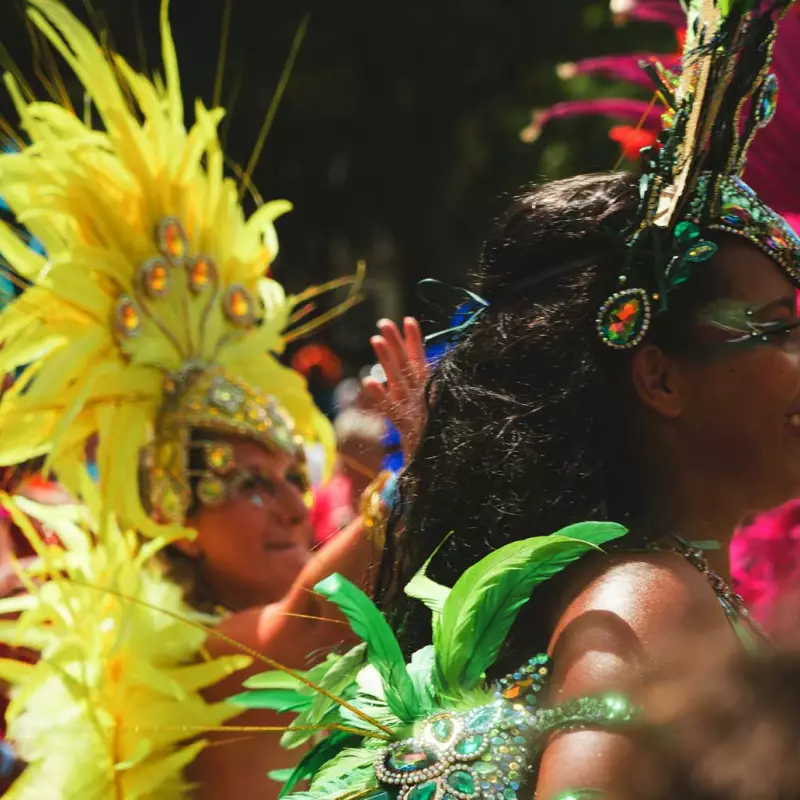
Each procession tells its own story through music, enormous floats, and carnival costumes – Rio prepares them for months: elaborate headdresses, hand embroidery, feathers, and sparkling details designed for the bright lights of the Sambadrome. When multi-meter platforms pass by the stands, light fractures through sequins and stones, and the music resonates in your chest. This is Brazil's carnival culture – loud, passionate, and surprisingly cohesive.
The parade will last all night. After it ends, you'll be driven back to your hotel.
If you want to experience the Carnival in Rio with an extended program that also includes Iguazu Falls and beach relaxation, consider our Brazil Carnival & Iguazu Beach Tour - 12 Days.
In the evening, a transfer will take you to the Sambadrome – Rio, the parade, and thousands of spectators merge here into one continuous movement. The stands rise to their feet at the first sounds of the orchestra, voices blend with the drums, and then the Brazilian samba schools take to the avenue.
Each procession tells its own story through music, enormous floats, and carnival costumes – Rio prepares them for months: elaborate headdresses, hand embroidery, feathers, and sparkling details designed for the bright lights of the Sambadrome. When multi-meter platforms pass by the stands, light fractures through sequins and stones, and the music resonates in your chest. This is Brazil's carnival culture – loud, passionate, and surprisingly cohesive.
The parade will last all night. After it ends, you'll be driven back to your hotel.
If you want to experience the Carnival in Rio with an extended program that also includes Iguazu Falls and beach relaxation, consider our Brazil Carnival & Iguazu Beach Tour - 12 Days.
countries/brazil/new-pics/karnaval/markus-kammermann-7y3-tvfi0k-unsplash.jpg
Day 4. Rio de Janeiro. Corcovado Tour to Christ the Redeemer. City Panorama
After breakfast, the Corcovado tour begins (4 hrs). From a small station, the train climbs the slope – almost immediately, the Tijuca Forest closes in outside the windows, Rio remains below, and dense canopies, vines, and moss-covered trunks surround you.
The Corcovado cog train gradually brings you to the summit. Here stands the Christ the Redeemer statue – Rio's tourist and spiritual symbol. Up close, the figure looks entirely different than from the city streets: you have to tilt your head back to see it fully.
From the viewing platform, you can see Guanabara Bay, the Niterói Bridge, Sugarloaf Mountain, the Botanical Garden, and Maracanã Stadium. The city below is divided by hills and waterways, so your gaze constantly shifts from one shore to another.
It's hard to imagine a tour of Brazil without a walk up Corcovado – here your English-speaking guide will tell you about the statue and the surrounding national park.
The Corcovado cog train gradually brings you to the summit. Here stands the Christ the Redeemer statue – Rio's tourist and spiritual symbol. Up close, the figure looks entirely different than from the city streets: you have to tilt your head back to see it fully.
From the viewing platform, you can see Guanabara Bay, the Niterói Bridge, Sugarloaf Mountain, the Botanical Garden, and Maracanã Stadium. The city below is divided by hills and waterways, so your gaze constantly shifts from one shore to another.
It's hard to imagine a tour of Brazil without a walk up Corcovado – here your English-speaking guide will tell you about the statue and the surrounding national park.
countries/brazil/new-pics/rio/rio-234.jpg
Day 5. Flight Rio – Foz do Iguaçu. Transfer to Hotel
After breakfast, you'll be taken to Rio airport. Then a flight to Foz do Iguaçu, a driver meet-and-greet, and transfer to your chosen hotel. The rest of the day can be spent resting before tomorrow's excursion.
Group tours to Brazil often turn here after bustling Rio, and the change is immediately noticeable. Foz do Iguaçu is surrounded by dense subtropical forest, with the region's main attraction hidden away from the city streets.
Iguazu is not like a single high waterfall. The river approaches the edge in a wide channel, meets basalt ledges, and breaks into countless cascades. Some are visible between the trees, while a constant mist hangs above others. So the Iguazu Falls tour is not about one viewpoint – it's a gradual approach to the powerful, thundering force of water.
For a Brazil-Argentina tour, this is a key stop. From the two banks, the falls look completely different, and in the coming days you'll see both sides.
For a more luxurious Carnival experience with elite hotels and exclusive services, explore our Luxury Brazil tour.
Group tours to Brazil often turn here after bustling Rio, and the change is immediately noticeable. Foz do Iguaçu is surrounded by dense subtropical forest, with the region's main attraction hidden away from the city streets.
Iguazu is not like a single high waterfall. The river approaches the edge in a wide channel, meets basalt ledges, and breaks into countless cascades. Some are visible between the trees, while a constant mist hangs above others. So the Iguazu Falls tour is not about one viewpoint – it's a gradual approach to the powerful, thundering force of water.
For a Brazil-Argentina tour, this is a key stop. From the two banks, the falls look completely different, and in the coming days you'll see both sides.
For a more luxurious Carnival experience with elite hotels and exclusive services, explore our Luxury Brazil tour.
countries/brazil/new-pics/iguasu/11.jpg
Day 6. Foz do Iguaçu. Excursion to the Brazilian Side of the Falls. Devil's Throat
After breakfast, it's time for the Iguazu excursion. Today you'll see the falls from the Brazilian side, where the trail runs along the edge of the canyon and gradually leads to open viewpoints.
The route passes through Iguazu National Park. The waterfalls didn't appear from a single eruption – the river spent centuries eroding cracks in ancient basalt layers until the escarpment split into multiple ledges. The name Iguazu comes from the Guarani language, meaning "Big Water."
At first, separate cascades appear between the trees. Further on, the forest opens up, and almost the entire bend of the canyon comes into view. The Brazilian side of Iguazu offers a rare opportunity to take in the falls in a single glance. Above the cliff, the river seems calm, but at the edge, the water shatters into dozens of streams and disappears into a white cloud.
The closer the trail gets to the Devil's Throat, the louder the roar. Speaking becomes difficult, clothes grow damp, and short rainbows flash above the walkway. Pure magic and pure joy!
For a deeper immersion into the world of Iguazu Falls, explore our Brazil New Year Tour: Rio, Iguazu & Amazon - 12 Days.
The route passes through Iguazu National Park. The waterfalls didn't appear from a single eruption – the river spent centuries eroding cracks in ancient basalt layers until the escarpment split into multiple ledges. The name Iguazu comes from the Guarani language, meaning "Big Water."
At first, separate cascades appear between the trees. Further on, the forest opens up, and almost the entire bend of the canyon comes into view. The Brazilian side of Iguazu offers a rare opportunity to take in the falls in a single glance. Above the cliff, the river seems calm, but at the edge, the water shatters into dozens of streams and disappears into a white cloud.
The closer the trail gets to the Devil's Throat, the louder the roar. Speaking becomes difficult, clothes grow damp, and short rainbows flash above the walkway. Pure magic and pure joy!
For a deeper immersion into the world of Iguazu Falls, explore our Brazil New Year Tour: Rio, Iguazu & Amazon - 12 Days.
countries/brazil/new-pics/iguasu/guilherme-madaleno-1139415-unsplash.jpg
Day 7. Foz do Iguaçu. Excursion to the Argentine Side of the Falls. Flight to Buenos Aires. Transfer to Hotel
The Iguazu Falls route – Brazil to Argentina – shows one river from two completely different perspectives. After breakfast, you'll head back to the falls with your English-speaking guide. The road crosses the Tancredo Neves Bridge over the Iguazu River.
Today, the Argentine side of Iguazu lets you get almost face-to-face with the cascades. Walkways are built over the river and at the foot of the ledges: water appears beneath your feet, at eye level – and spray reaches the platform before you even see the stream itself. The man-made paths and crossings, allowing views from above and beside the cascades, are truly impressive.
The highlight is the Devil's Throat waterfall – the widest of the cascades, plunging into the canyon of the same name. First, a white cloud appears above the forest, then you hear the rumble. At the edge, you have to stop: the river plunges into the gorge so close that your voice is lost in the noise.
After the excursion, you'll be taken to the airport. Flight to Buenos Aires, driver meet-and-greet, and transfer to your hotel.
Today, the Argentine side of Iguazu lets you get almost face-to-face with the cascades. Walkways are built over the river and at the foot of the ledges: water appears beneath your feet, at eye level – and spray reaches the platform before you even see the stream itself. The man-made paths and crossings, allowing views from above and beside the cascades, are truly impressive.
The highlight is the Devil's Throat waterfall – the widest of the cascades, plunging into the canyon of the same name. First, a white cloud appears above the forest, then you hear the rumble. At the edge, you have to stop: the river plunges into the gorge so close that your voice is lost in the noise.
After the excursion, you'll be taken to the airport. Flight to Buenos Aires, driver meet-and-greet, and transfer to your hotel.
countries/brazil/new-pics/iguasu/jonatan-lewczuk-1328947-unsplash.jpg
Day 8. Buenos Aires. City Tour. La Boca, San Telmo, Plaza de Mayo, Recoleta. Evening – Tango Show
After breakfast, we'll set off on a Buenos Aires city tour with your English-speaking guide (3 hours). The colorful facades of La Boca sit alongside the bars and antique shops of San Telmo, while wide avenues lead to the quiet streets of Recoleta.
At Plaza de Mayo, Buenos Aires turns more serious. Here stands the Casa Rosada – the presidential palace, woven into the country's political history and linked to the name of Evita Perón. In the center, old facades reflect in office windows, office workers hurry between buses, and no one rushes at café tables. Along the way, you'll see the Obelisk, 9 de Julio Avenue, and modern Puerto Madero.
The city draws you in with its easy transitions: just a few blocks separate the old port from French-style facades, and business towers from cafes with wooden tables.
In the evening, a tango show in Buenos Aires awaits, with dinner and wine. The orchestra plays live – couples freeze, then draw sharply together, heels striking a dry beat. Gradually, you stop following the technique – what remains on stage is a wordless conversation, intimate and slightly theatrical.
For connoisseurs of Argentine culture and gastronomy, we recommend the Luxury Argentina Tour - 11 Days with an even more extensive program.
At Plaza de Mayo, Buenos Aires turns more serious. Here stands the Casa Rosada – the presidential palace, woven into the country's political history and linked to the name of Evita Perón. In the center, old facades reflect in office windows, office workers hurry between buses, and no one rushes at café tables. Along the way, you'll see the Obelisk, 9 de Julio Avenue, and modern Puerto Madero.
The city draws you in with its easy transitions: just a few blocks separate the old port from French-style facades, and business towers from cafes with wooden tables.
In the evening, a tango show in Buenos Aires awaits, with dinner and wine. The orchestra plays live – couples freeze, then draw sharply together, heels striking a dry beat. Gradually, you stop following the technique – what remains on stage is a wordless conversation, intimate and slightly theatrical.
For connoisseurs of Argentine culture and gastronomy, we recommend the Luxury Argentina Tour - 11 Days with an even more extensive program.
countries/argentina/new-photos/buenos-ajres/ba12.jpg
Day 9. Buenos Aires. Free Day.
A free day can be spent in Buenos Aires or exploring the city's northern suburbs. First stop – San Isidro, Buenos Aires fades behind you quickly. Noisy streets give way to low houses, green neighborhoods, and historic mansions. This suburb has long been chosen for a quieter life away from the center.
countries/argentina/new-photos/buenos-ajres/ba2.jpg
Optional Excursions: Tigre*
About 40 kilometers from the capital, Tigre begins. Here you'll board a boat and travel through canals lined with docks, riverside houses, and small islands. The Tigre river delta lives by its own rules – instead of streets, there are channels, and boats serve as everyday transport for locals. From the water, you can feel just how quickly the capital gives way to tranquil river life.
In Tigre, Argentina, the excursion runs as a shared group tour with an English-speaking guide. Price: USD 100 per person.
In Tigre, Argentina, the excursion runs as a shared group tour with an English-speaking guide. Price: USD 100 per person.
countries/argentina/new-photos/buenos-ajres/ba10.jpg
Optional Excursions: Montevideo*
Montevideo is reached by water. In the morning, a driver will take you to the port, then the Buenos Aires – Montevideo ferry crosses the wide Río de la Plata. On the Uruguayan side, an English-speaking guide will meet you, and the city tour will continue by vehicle.
In Montevideo, Uruguay, the excursion covers the port, Independence Square, and the Cathedral. Then you'll drive through the center and walk the streets of the Old City. Here the buildings are lower, there's less hurry, and the water disappears behind the blocks only to reappear at the end of the street. Montevideo remains low and spacious. Between the old center and the port, you can feel that the city grew beside a vast river that looks more like the sea.
Time will remain before the return crossing for lunch and a self-guided stroll. We'll return to Buenos Aires in the evening, with a transfer from the port to your hotel.
Tickets included. Shared group tour with English-speaking guide – USD 500. Private option with an English-speaking guide, minimum two guests – USD 850 per person.
In Montevideo, Uruguay, the excursion covers the port, Independence Square, and the Cathedral. Then you'll drive through the center and walk the streets of the Old City. Here the buildings are lower, there's less hurry, and the water disappears behind the blocks only to reappear at the end of the street. Montevideo remains low and spacious. Between the old center and the port, you can feel that the city grew beside a vast river that looks more like the sea.
Time will remain before the return crossing for lunch and a self-guided stroll. We'll return to Buenos Aires in the evening, with a transfer from the port to your hotel.
Tickets included. Shared group tour with English-speaking guide – USD 500. Private option with an English-speaking guide, minimum two guests – USD 850 per person.
countries/uruguay/montevideo/montevideo-22.jpg
Optional Excursions: Fiesta Gaucha*
For the Fiesta Gaucha, you'll head out of town – about 80 kilometers from Buenos Aires. A full day at a ranch among the open spaces of the Pampas lies ahead. Originally, gauchos didn't stay in one place for long, herding cattle across the plains – settled life, farming, and ranching came later.
Today, gauchos at the Argentine ranch demonstrate horsemanship, riding skills, and lasso work. A special highlight is the boleadoras – three weights connected by straps, thrown to entangle an animal's legs. The swift motion is hard to follow the first time.
After the equestrian display, you'll be invited to a traditional Argentine feast. Here, the gaucho story stops being a museum piece – it's passed on through riding mastery and the shared meal.
Duration: 8 hours. Lunch included. Shared group tour with an English-speaking guide. Price: USD 250 per person.
Today, gauchos at the Argentine ranch demonstrate horsemanship, riding skills, and lasso work. A special highlight is the boleadoras – three weights connected by straps, thrown to entangle an animal's legs. The swift motion is hard to follow the first time.
After the equestrian display, you'll be invited to a traditional Argentine feast. Here, the gaucho story stops being a museum piece – it's passed on through riding mastery and the shared meal.
Duration: 8 hours. Lunch included. Shared group tour with an English-speaking guide. Price: USD 250 per person.
countries/argentina/new-photos/sergey-mikheev-bztskecromg-unsplash-oblozhka.jpg
Day 10. Transfer to Buenos Aires Airport. Departure Home
After breakfast, at the scheduled time, a driver will meet you and take you to Buenos Aires airport. The journey ends, but the road home rarely feels like just a program point.
From your Brazil and Argentina getaway, the most vivid scenes will stay with you. Rio with the drums of the Sambadrome and floats glittering under spotlights. Iguazu with wet clothes and a roar that makes speech useless – only silent awe remains. Buenos Aires with its narrow streets, the orchestra, and that long pause before the dancers move.
And so a Carnival tour to Brazil becomes your personal reserve of energy. Months later, just a samba melody, the scent of rain, or a photo from the waterfalls can brighten an ordinary day. The South America tour is complete, but the pleasure lingers. These memories will return throughout the year – warming you, supporting you, and reminding you how much more is still waiting to be seen.
To discover more of the continent’s highlights, our Great South America tour covers Brazil, Argentina, Chile, Bolivia, and Peru.
From your Brazil and Argentina getaway, the most vivid scenes will stay with you. Rio with the drums of the Sambadrome and floats glittering under spotlights. Iguazu with wet clothes and a roar that makes speech useless – only silent awe remains. Buenos Aires with its narrow streets, the orchestra, and that long pause before the dancers move.
And so a Carnival tour to Brazil becomes your personal reserve of energy. Months later, just a samba melody, the scent of rain, or a photo from the waterfalls can brighten an ordinary day. The South America tour is complete, but the pleasure lingers. These memories will return throughout the year – warming you, supporting you, and reminding you how much more is still waiting to be seen.
To discover more of the continent’s highlights, our Great South America tour covers Brazil, Argentina, Chile, Bolivia, and Peru.
countries/argentina/new-photos/daniel-tong-vtjtaz-rxxi-unsplash.jpg
Dreams Come True on Carnival
PayPal
You can pay by simply choosing PayPal at checkout
Do you have questions?
Call us right now to get your questions answered.
-
 Package
- Booking Code: drc25
- Availability: Available for Booking
- Total: $3,725