
Click Image for Gallery
Discover the most beautiful places of South America in one tour 2026!
Peru, Bolivia & Chile (+Easter Island Extension)
Day 1: Arrival in Lima, Gateway to the Inca Empire
You arrive in Lima and a driver meets you at the airport and takes you to your hotel. Lima is the capital of Peru. It was built by Francisco Pizarro in 1535 on the coast of the Pacific Ocean. In the old days, people called it the City of Kings. In 1551, the oldest university on the continent, the University of San Marcos, was built here. Around Plaza Mayor, the main square of the city, you find the best sights: old colonial buildings from the 16th century, the Archbishop's Palace with beautiful carved balconies, the Cathedral of Lima, and the Government Palace of Peru. A big earthquake in 1746 changed parts of the city, but the main layout stayed the same. Meeting Lima gives you a feeling of contrast: a busy city, a shimmering Pacific horizon, and wind carrying the sound of waves.
This is where your Peru tours and your 14 day South America tour begin.
This is where your Peru tours and your 14 day South America tour begin.
Lima.jpg
Day 2: Lima City Tour, Colonial History and Ocean Views
After breakfast, your guide takes you on a Lima city tour. You start in the historic district. You walk across Plaza Mayor and look at the 16th-century colonial buildings. Then you visit the San Francisco Monastery complex, where you see a painting called The Last Supper by Diego de la Puente. Christ and the apostles are shown eating their last meal together.
The walk takes you through parks, past museums and galleries, along narrow streets under old wooden balconies, and through markets. Lima opens up slowly: the ringing of bells, the shade of inner courtyards, the smell of warm wood and stone. The strict shape of the squares and, sometimes, the gentle sound of the ocean.
You can also visit the Larco Museum. It is a big house built on top of a 7th-century pre-Columbian pyramid. The museum is worth visiting for its rich storage vault and its unique collection of pre-Columbian erotic pottery.
The walk takes you through parks, past museums and galleries, along narrow streets under old wooden balconies, and through markets. Lima opens up slowly: the ringing of bells, the shade of inner courtyards, the smell of warm wood and stone. The strict shape of the squares and, sometimes, the gentle sound of the ocean.
You can also visit the Larco Museum. It is a big house built on top of a 7th-century pre-Columbian pyramid. The museum is worth visiting for its rich storage vault and its unique collection of pre-Columbian erotic pottery.
countries/peru/prezind-palace-lima.png
Day 3: Fly to Cusco, Temple of Coricancha and Sacsayhuaman Fortress
Breakfast. Transfer to the airport for the flight to Cusco, a city in Peru. Transfer to the hotel. In the afternoon, your guide takes you on a Cusco tours city tour.
Cusco was the capital of the Inca Empire, which joined a large part of the Andes together and built a complex system of roads and temples. You see the Inca sights. You start with Qorikancha (the Coricancha Temple), the Temple of the Sun, where the winter solstice celebration was held. Then you visit the Kenko stone sanctuary, the red fortress of Puca Pucara, and Tambomachay, the Inca center for worshipping water. Finally, you visit Sacsayhuaman, a big complex of religious buildings, a fortress, towers, and water channels, all built from enormous stone blocks.
Reach out your hand and you are touching the past of pre-Columbian America.
Note: if you want to extend your time in the Sacred Valley tour area before heading to Machu Picchu, you can add a visit to Ollantaytambo, the well-preserved Inca fortress town, and Maras Moray, a fascinating site of circular Inca terraces used to study agriculture. Ask us about this optional extension.
Cusco was the capital of the Inca Empire, which joined a large part of the Andes together and built a complex system of roads and temples. You see the Inca sights. You start with Qorikancha (the Coricancha Temple), the Temple of the Sun, where the winter solstice celebration was held. Then you visit the Kenko stone sanctuary, the red fortress of Puca Pucara, and Tambomachay, the Inca center for worshipping water. Finally, you visit Sacsayhuaman, a big complex of religious buildings, a fortress, towers, and water channels, all built from enormous stone blocks.
Reach out your hand and you are touching the past of pre-Columbian America.
Note: if you want to extend your time in the Sacred Valley tour area before heading to Machu Picchu, you can add a visit to Ollantaytambo, the well-preserved Inca fortress town, and Maras Moray, a fascinating site of circular Inca terraces used to study agriculture. Ask us about this optional extension.
countries/peru/cusco-4.jpg
Day 4: Machu Picchu, The Lost City of the Incas
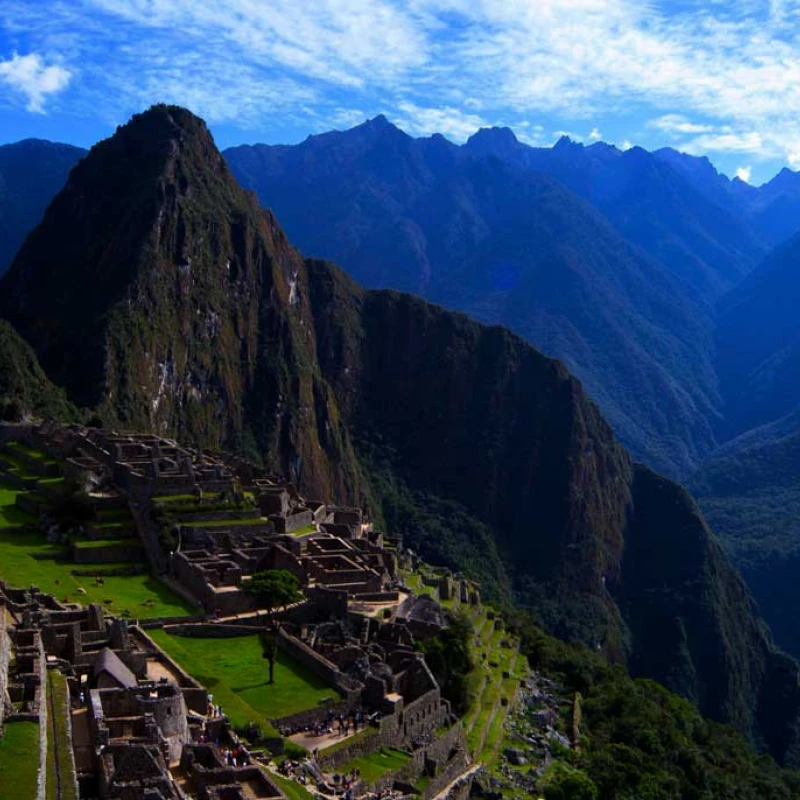
Breakfast. Transfer to the train station and then a train through the Sacred Valley tour to the town of Aguas Calientes. A bus then takes you up to Machu Picchu, one of the Wonders of the World, the Machu Picchu tours lost city of the Incas.
Machu Picchu sits on top of a mountain surrounded by thick jungle. It was built in the 15th century by order of Pachacutec, and abandoned for unknown reasons. Only in 1911 did the archaeologist Hiram Bingham find it again. But the ancient Inca city was not properly explored until the 1940s, when an archaeological expedition found the paved Inca Trail that leads to it through the Sacred Valley tour.
Stories about the energy of this Inca capital are told around the world. This is an Exclusive Machu Picchu tour experience: private, guided, and timed to give you the best of the site.
How to get to Machu Picchu: you take a train from Cusco through the Sacred Valley. Your Vistadome train ticket is already included.
Lunch included. Return to Cusco by train. Transfer to hotel.
Machu Picchu sits on top of a mountain surrounded by thick jungle. It was built in the 15th century by order of Pachacutec, and abandoned for unknown reasons. Only in 1911 did the archaeologist Hiram Bingham find it again. But the ancient Inca city was not properly explored until the 1940s, when an archaeological expedition found the paved Inca Trail that leads to it through the Sacred Valley tour.
Stories about the energy of this Inca capital are told around the world. This is an Exclusive Machu Picchu tour experience: private, guided, and timed to give you the best of the site.
How to get to Machu Picchu: you take a train from Cusco through the Sacred Valley. Your Vistadome train ticket is already included.
Lunch included. Return to Cusco by train. Transfer to hotel.
Machu Picchu.jpg
Day 5: Drive from Cusco to Puno, Andes and La Raya Pass
Breakfast and then a comfortable bus ride to the city of Puno, Peru. The route passes through Andahuaylillas, sometimes called the Sistine Chapel of South America, and then deeper into the Andes, where the Inca temple at Raqchi has been preserved.
Lunch in Sicuani. Then the road climbs to the La Raya Pass, 4,200 meters above sea level. The wind is sharp here and a market stretches along the roadside against a background of snowy peaks. You pass Pucara, an ancient pre-Columbian fortress. By evening, you arrive in Puno, the city on Lake Titicaca. The cold air of the Bolivian altiplano, the high-altitude plateau of the central Andes, is already in the air here.
Lunch in Sicuani. Then the road climbs to the La Raya Pass, 4,200 meters above sea level. The wind is sharp here and a market stretches along the roadside against a background of snowy peaks. You pass Pucara, an ancient pre-Columbian fortress. By evening, you arrive in Puno, the city on Lake Titicaca. The cold air of the Bolivian altiplano, the high-altitude plateau of the central Andes, is already in the air here.
countries/peru/puca-pucara-2.jpg
Day 6: Lake Titicaca, Uros Floating Islands
After breakfast, you take a boat out across the world's highest navigable lake to the Uros floating islands as part of your Lake Titicaca tours. The lake opens up slowly: cold, flat water, morning light playing on the surface, banks disappearing in the haze. The islands are built from totora reed, and the Aymara people, who live on them, have kept their traditional way of life, clothing, and ceremonies. Reed is used for houses, boats, and food. Fishing is still the main way of life. They also make simple souvenirs for visitors. Their traditional clothing, including layered skirts, bowler hats, and bright ponchos, is still part of everyday life, simple and unchanged.
Return to Puno, transfer to hotel.
Return to Puno, transfer to hotel.
countries/peru/8878.jpg
Day 7: Travel from Puno to La Paz, Crossing into Bolivia
After breakfast, you take a bus from Puno to Copacabana, a small Bolivian town on the shore of Lake Titicaca. It is known for its colonial cathedral and its pilgrimages to the Virgin of Copacabana, a statue from the 16th century. The road follows the water, then climbs up onto the plateau. By evening, you arrive in La Paz, the de facto capital of Bolivia, which spreads across a canyon surrounded by mountains. The streets are steep, houses seem to grow out of the hillsides, and snowy peaks are visible on the horizon. Ahead: the Salar de Uyuni, the Eduardo Avaroa National Reserve, high-altitude lagoons, and geysers.
Arrival, welcome, and transfer to hotel.
Arrival, welcome, and transfer to hotel.
countries/peru/tititkaka-33.jpg
Day 8: La Paz City Tour, Witches' Market and Panoramas of the Andes
After breakfast, your guide takes you on a La Paz city tour (4 hours). You start in the center: Plaza Murillo, the Government Palace, the Cathedral, and the Church of San Francisco. Then comes the most atmospheric part of the tour: the Witches' Market in Bolivia, also known as the Mercado de las Brujas. Here you find herbs, amulets, ritual objects, and indigenous Bolivian people in traditional clothing. After that, you enjoy a view of the city and the volcano crater from the Killi Killi viewpoint.
In the Miraflores neighborhood, you visit an open-air museum about the Tiwanaku ruins, also known as the Tiahuanaco civilization, the pre-Hispanic indigenous culture that built enormous stone structures in the Andes long before the Incas. Finally, you walk through the upscale districts of Obrajes, Calacoto, and La Florida, which are close to the Moon Valley, a labyrinth of otherworldly canyons and giant rock spires.
In the Miraflores neighborhood, you visit an open-air museum about the Tiwanaku ruins, also known as the Tiahuanaco civilization, the pre-Hispanic indigenous culture that built enormous stone structures in the Andes long before the Incas. Finally, you walk through the upscale districts of Obrajes, Calacoto, and La Florida, which are close to the Moon Valley, a labyrinth of otherworldly canyons and giant rock spires.
countries/bolivia/la-paz-2.jpg
Day 9: Fly to Uyuni, Salt Flats, Train Cemetery and Salt Hotel
Breakfast. Transfer to the airport and flight to the Salar de Uyuni in Bolivia. This is the largest dried salt lake on Earth, sitting at 3,650 meters above sea level. In the rainy season, the Salar de Uyuni becomes an enormous mirror: a thin layer of water reflects the sky perfectly, and the horizon line disappears.
A jeep expedition takes you through the This is a full Uyuni Salt Flats tour, part of a Uyuni salt flats itinerary 3 days program.Train Cemetery Uyuni and across the salt fields to Incahuasi Island, also called Fish Island, where giant cactus plants grow. You see the Stone Forest and visit the salt factory in Colchani. Then you visit the Palacio de Sal, a hotel built completely from salt. People say the air there helps with lung problems.
At night, the salt flat is one of the best places on Earth to look at the stars. With no city lights for hundreds of kilometers around, the sky is incredible. This is stargazing Uyuni luxury at its finest. After lunch on the salt flat, you head to an island to explore the 800-year-old mummies of Coqueza, which are remains found in a sacred cave at the foot of a volcano. You also visit the town of Tahua, which sells souvenirs made from salt. Uyuni stargazing is one of the most magical experiences in all of South America.
Overnight in Uyuni.
A jeep expedition takes you through the This is a full Uyuni Salt Flats tour, part of a Uyuni salt flats itinerary 3 days program.Train Cemetery Uyuni and across the salt fields to Incahuasi Island, also called Fish Island, where giant cactus plants grow. You see the Stone Forest and visit the salt factory in Colchani. Then you visit the Palacio de Sal, a hotel built completely from salt. People say the air there helps with lung problems.
At night, the salt flat is one of the best places on Earth to look at the stars. With no city lights for hundreds of kilometers around, the sky is incredible. This is stargazing Uyuni luxury at its finest. After lunch on the salt flat, you head to an island to explore the 800-year-old mummies of Coqueza, which are remains found in a sacred cave at the foot of a volcano. You also visit the town of Tahua, which sells souvenirs made from salt. Uyuni stargazing is one of the most magical experiences in all of South America.
Overnight in Uyuni.
catalog/product/u/y/pierre-ricadat-518900-unsplash.jpg
Day 10: Uyuni, Altiplano Plateau, High-Altitude Lagoons and Siloli Desert
After breakfast, you drive toward Ojo de Perdiz, a small settlement on the edge of the Siloli Desert, known for its local textiles in rich natural colors. The road crosses the Bolivian altiplano, where the Bolivian Andes open out into wide and windy flat lands.
Then come the lagoons: Laguna Hedionda, Laguna Honda, Cañapa, and Ramaditas. They are all near the Eduardo Avaroa National Reserve on the Bolivian Altiplano, not far from the border with Chile. The color of the water in each lagoon changes depending on the season, the mineral salts in it, and their concentration.
A lunch box is provided on the road. Arrival and check-in at Hotel Ojo de Perdiz: adobe walls, wool textiles, the silence of the desert. Dinner included. Overnight.
Then come the lagoons: Laguna Hedionda, Laguna Honda, Cañapa, and Ramaditas. They are all near the Eduardo Avaroa National Reserve on the Bolivian Altiplano, not far from the border with Chile. The color of the water in each lagoon changes depending on the season, the mineral salts in it, and their concentration.
A lunch box is provided on the road. Arrival and check-in at Hotel Ojo de Perdiz: adobe walls, wool textiles, the silence of the desert. Dinner included. Overnight.
countries/bolivia/elizabeth-gottwald-1648757-unsplash.jpg
Day 11: Travel to San Pedro de Atacama, Laguna Colorada, Geysers and Laguna Verde
After breakfast, the road leads to the lagoons of southern Bolivia. First stop: Laguna Colorada. Here, James's flamingos feed in the red water, pale pink birds against cold brown mountains. This lagoon changes from scarlet to deep dark red depending on the light and the minerals. Then the route goes to Sol de Mañana: the ground breathes steam here and geysers shoot jets of hot mud with a hissing sound. At Chalviri Lake, you can bathe in natural hot springs. Finally, you arrive at Laguna Verde, an emerald-green lake at the foot of a volcano. All around: the tough Bolivian Andes, a cold wind, and a transparent sky.
Transfer across the border to San Pedro de Atacama tours is the base for all Atacama Desert tours in Chile. Day trips include the Moon Valley Atacama (Valle de la Luna) at sunset, the Tatio Geysers at sunrise, the Altiplanic Lagoons with flamingos, and the famous Miscanti and Miñiques lagoons high up in the mountains.San Pedro de Atacama tours in Chile. Check-in at hotel.
Transfer across the border to San Pedro de Atacama tours is the base for all Atacama Desert tours in Chile. Day trips include the Moon Valley Atacama (Valle de la Luna) at sunset, the Tatio Geysers at sunrise, the Altiplanic Lagoons with flamingos, and the famous Miscanti and Miñiques lagoons high up in the mountains.San Pedro de Atacama tours in Chile. Check-in at hotel.
countries/chile/chi-atacama-left.jpg
Day 12: Fly to Santiago, Rest in the Capital of Chile
After breakfast, transfer to Calama airport and flight to Santiago, Chile. Your guide meets you at the airport and takes you to the hotel.
Santiago is the capital of Chile. It sits in a wide valley between the Andes mountains and the Pacific Ocean. It was built here in the 16th century and over time became the main political and cultural center of the country. Today it is a calm, green city with parks, boulevards, and viewpoint hills. In clear weather, the snowy Andes ridge is visible above the rooftops. After check-in, you have free time. You can walk along the main streets, feel the rhythm of the city, and enjoy the soft evening light. Your Chile tours and Santiago de Chile tours begin here. In the evening, Lima offers some of the best fine dining Lima restaurants in all of South America. This is also the beginning of a complete 2 week South America itinerary - a Peru Bolivia Chile itinerary 14 days through Peru, Bolivia tours stops, and Chile, all in one seamless trip.
Santiago is the capital of Chile. It sits in a wide valley between the Andes mountains and the Pacific Ocean. It was built here in the 16th century and over time became the main political and cultural center of the country. Today it is a calm, green city with parks, boulevards, and viewpoint hills. In clear weather, the snowy Andes ridge is visible above the rooftops. After check-in, you have free time. You can walk along the main streets, feel the rhythm of the city, and enjoy the soft evening light. Your Chile tours and Santiago de Chile tours begin here. In the evening, Lima offers some of the best fine dining Lima restaurants in all of South America. This is also the beginning of a complete 2 week South America itinerary - a Peru Bolivia Chile itinerary 14 days through Peru, Bolivia tours stops, and Chile, all in one seamless trip.
countries/chile/chi-santiago-right.jpg
Day 13: Santiago City Tour, La Moneda and Santa Lucia Hill
Breakfast at the hotel, then a Santiago city tour with an English-speaking guide. You start at La Moneda Palace, a neoclassical building from the late 18th century where the government of Chile works today. Then Plaza de Armas, the historic heart of the city, with the Cathedral, the City Hall, and old administrative buildings. A climb up Santa Lucia Hill gives you a panoramic view of the capital: the streets lead all the way to the foot of the Andes. Then the route takes you through the modern districts of Vitacura, Las Condes, and Providencia, alongside the Mapocho River. The warm stone of old facades, air that smells of dust and leaves. A trip to Chile is not complete without this. This South America small group tours style of travel, built as a private Andes expedition through three countries, gives you an experience that a standard package simply cannot match.
Optional extra: a trip to the wine regions of Chile with a wine tasting Chile session ($230 per person, minimum 2 people).
You can also continue your South America journey and visit the legendary Iguazu Falls. Ask us about our individual tours to Brazil and Argentina.
Optional extra: a trip to the wine regions of Chile with a wine tasting Chile session ($230 per person, minimum 2 people).
You can also continue your South America journey and visit the legendary Iguazu Falls. Ask us about our individual tours to Brazil and Argentina.
countries/chile/chi-santiago-left.jpg
Day 14: Departure from Santiago
Breakfast at the hotel. Transfer to the airport, check-in for the international flight home. Safe travels! This was one of the Best South America tours available: a complete all-inclusive South America tour built as Private tours Peru Bolivia Chile with expert local guides at every stop. From luxury tours to Machu Picchu and Uyuni to the desert of the Atacama, this Peru Bolivia Chile tour covers it all in 14 days.
countries/chile/santiago-2.jpg
Optional Extension: Easter Island, 3 Days / 2 Nights
During a tour to Easter Island, you see the famous Moai statues that line the coast, and visit several archaeological zones on the island. These stone statues, up to 10 meters tall, are carved from volcanic rock and show the ancestors of the Rapa Nui people. Scientists believe Easter Island was once covered in palm forests. But as the population grew, the trees were cut down faster than they could grow back. Over time the trees disappeared, the soil got weak, and the islanders began building the Moai statues to try to bring back the favor of the spirits. Amid the wind and the sound of the ocean, the Easter Island statues look stern and calm. The wind passes between them like through an ancient guard.
countries/chile/ostrov-paskhi/sheila-c-1-bmyenbaky-unsplash.jpg
Anakena Beach Excursion (Full Day, Lunch Box Included)
The route follows the coast of Rapa Nui. First: Ahu Akahanga, where legend says the first king of the island, Hotu Matua, is buried. Then the Rano Raraku volcano, the quarry where the Moai statues were carved. On its slopes lie dozens of unfinished figures, as if time stopped. A lunch box is served on the windy plateau. Then Ahu Tongariki, the largest platform on the island, where 15 restored Moai statues stand. Then the Poike Peninsula and Ahu Te Pito Kura, which has the largest statue on the island. The day ends at Anakena beach: warm turquoise water, white sand, and palm trees. Return to Hanga Roa in the evening through the center of the island. The ocean makes noise against the rocks, the wind smells of salt and grass.
countries/chile/ostrov-paskhi/livia-enomoto-rnlucminugq-unsplash.jpg
Orongo Excursion (4 Hours)
You walk along the grey-green slopes of Rano Kau volcano to a viewpoint at the edge of the crater. From here you see a calm lake inside the crater, surrounded by dark rock. Where the water is not covered by green plants, it reflects the clouds. Then you visit the village of Orongo, a ceremonial center of Rapa Nui where the Tangata Manu, the Bird Man, was chosen. In spring, the clans of Easter Island gathered here waiting for the return of the Manu Tara bird. Participants climbed down the cliffs and swam to a small islet to bring back the first egg.
countries/chile/ostrov-paskhi/franz-nawrath-0knpshthjjq-unsplash.jpg
Akivi Excursion (4 Hours)
You drive to the archaeological zones in the center of Easter Island. The route leads to Ahu Akivi, a platform with seven Moai statues that face the ocean, which is unusual for the island. According to tradition, they represent the first sailors of the Rapa Nui people who arrived from across the Pacific Ocean. Then Puna Pau, a small hill where the red tufa for the cylindrical headdresses of the Moai statues was quarried. From the viewpoint here, you see Hanga Roa and the quiet bays of the coast below.
countries/chile/ostrov-paskhi/thomas-griggs-2qjk2pfah3o-unsplash.jpg
Great South America Tour
PayPal
You can pay by simply choosing PayPal at checkout
Do you have questions?
Call us right now to get your questions answered.
-
 Package
- Booking Code: GSATour
- Availability: Available for Booking
- Total: $7,336